Exclusive: Five million downloads later, GameHub is ready to talk
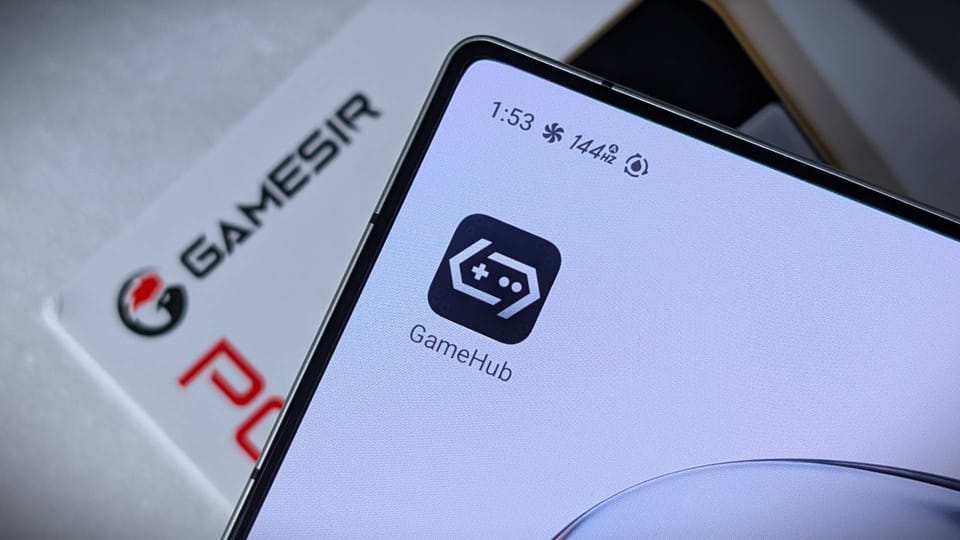
Hello and welcome to a special edition of The Memory Core newsletter that’s all about GameHub, GameSir, and its efforts to go legit.
I’ve been working on this scoop for longer than I care to admit, and there’s a healthy dose of exclusive info. Here’s the short version:
- GameHub’s user base is 5 million strong, with roughly 70-80% in China (as of November 2025).
- GameFusion (the Windows emulator) is fully developed in-house, and the company is firm that it’s compliant with open-source licenses.
- GameSir claims it remains committed to contributing to the community in the long term, despite providing little evidence to support this claim.
- The company was surprised by GameHub Lite, which uses its proprietary code, but has no plans to shut it down.
- A “very big version upgrade” is coming to GameHub soon, after being pushed to shift resources to a different GameSir project.
GameHub steps into the spotlight
GameHub was one of the first Windows emulation apps on Android to make the process feel mainstream. It hid Winlator’s complexity, added direct Steam downloads, and pushed toward a plug-and-play experience.
But the app immediately became a lightning rod for controversy. Accusations of stolen open-source code, invasive trackers, and required logins quickly overshadowed its technical achievements.
So I reached out, and the company was open to responding to community criticism. In fact, it was surprised that no one had reached out sooner.
GameSir says there’s an important distinction: GameFusion is the Windows emulator, while GameHub is the front-end launcher. It’s designed as a hub for all games on your phone, not just PC emulation, which aligns neatly with GameSir’s core business: selling controllers. In markets like China, especially, mobile games remain the primary focus.
The app is designed to provide a controller-friendly interface for mobile titles and controller-mapping tools for games without native controller support. It also supports local streaming via Apollo and PS Link. PC emulation is just one of many features, rather than the main one.
From the very beginning, some community members were wary of how closely GameHub ties into GameSir’s hardware business. This is a major difference between GameFusion and other open-source PC emulators, like Winlator.
GameSir doesn’t dispute that its primary motivation for creating a plug-and-play mobile gaming experience is to sell more controllers, and that it does “plan to release controller models that are deeply optimized for GameHub,” which it sees as “a core part of the GameSir ecosystem.”
But the company is also very sensitive to community feedback.
Privacy concerns on a massive scale
Early GameHub builds shipped with a large number of built-in trackers, leading to serious criticism and the development of GameHub Lite (more on this later).
The company insisted that these trackers had no malicious purpose, but rather followed Chinese development norms of turning everything on by default, since the Chinese market is much less sensitive to trackers than global users.
In any case, it has since removed many third-party SDKs and plugins for Chinese social login features from the global version. It’s also been checked and approved for listing on the Google Play Store.
As for the Windows emulator, the company says it is “developed in-house by GameSir’s core engineering team, composed of veterans with deep expertise in game systems, virtualization, and GPU rendering—some of the best in the field.”
Another GameSir employee revealed that PC emulator development is largely a passion project from the company’s lead developer. One that has helped differentiate the company’s app from competitors.
The company revealed that the app’s user base was approaching 5 million back in November 2025. Since then, the official Discord server has grown from 30,000 members to more than 40,000 members. On Google Play, the app now lists more than 1 million downloads, and it’s only been available for three months.
(Note: I asked the company for updated user numbers, but it didn't reply in time for publication. I'll update you all when I hear back.)
A separate rep estimated that roughly 70-80% of GameHub’s users are in China, where GameSir sells most of its telescopic controllers.
Code, credits, and contradictions
While GameSir is making partially transparent efforts to create a more privacy-friendly experience for global users, the legitimacy of the app’s development practices has also come under fire.
The company writes that “The core of the emulator is entirely self-developed,” while also acknowledging that it does “reference and use UI components from Winlator… to maintain ecosystem compatibility and familiarity.”
Winlator is licensed under the MIT license, which is permissive and doesn't require derivative apps to reveal their source code. However, it still requires attribution.
I couldn’t find clear attribution inside the app or its materials for Winlator or other major open-source components commonly used in Windows emulation or Steam integration.
For other elements incorporated into GameFusion, like Wine, the company relies on its "own in-house compatibility layer (such as syscall hooks, GameScopeVK, and other technologies), rather than modifications to Wine’s core code.”
To understand that defense, it helps to look at how proprietary software often builds on open-source foundations.
Compatibility layers enable companies to build proprietary products on open-source foundations. For example, Chrome is built on open-source Chromium.
That said, this strategy also conflicts with other statements the company has given. It claims that the team is committed to giving back to the community as a whole, writing (emphasis theirs):
"We actively contribute improvements that can be shared back to the upstream community through pull requests, patches, or other appropriate collaboration methods, aiming to help the ecosystem evolve together.
We’re also establishing a more structured open-source contribution workflow to better balance compliance and commercial needs. Additionally, we are collaborating closely with chipset vendors such as Qualcomm and MediaTek, and our work on graphics driver optimization benefits the broader ecosystem. Our long-term contribution to the community extends far beyond what may be immediately visible.”
Despite this, I could not find any significant commits on the company’s official GitHub profile. Only 7 contributions have been made in the past year.
I asked GameSir about this directly, and they responded with the statement below.
"We rarely update the public code repositories manually, because at the moment there are no special changes or custom commits to Wine itself. That said, the repositories do pull upstream updates periodically, though this usually doesn’t carry much practical significance.”
I have yet to see any open-source code contributed by the company to any other project. That doesn’t rule out the possibility that individual members of the GameSir dev team have contributed, or that collaboration with chipset vendors has led to tangible improvements in drivers.
It’s also worth pointing out that years ago, GameSir released a Nintendo Switch emulator called EggNS, which appeared to use code from Yuzu. That app was later made inaccessible to users without a GameSir controller, then removed entirely.
EggNS is a sore spot for the company, and it has learned from the experience. A rep assured me that “GameHub will be a much more friendly & legit software.”
The community-made alternatives
At this point, GameHub/GameFusion isn’t the only plug-and-play PC emulator on Android, with open-source alternatives like GameNative quickly gaining steam. Or more literally, adding support for Steam, GoG, and Epic Games.
Every PC emulator on Android relies on the same underlying technology. Advances in Proton and FEX (both bankrolled by Valve), as well as DXVK, Box64, and others, are key cogs in the machine that have improved PC emulation on Android over the past year.
But if there’s one app I see recommended more than any other, it’s GameHub Lite. This stripped-down version of GameHub was originally created by Clippy in response to the backlash against excessive tracking in GameHub. It was later taken over by Producdevity of EmuReady.
Ironically, GameHub Lite exists in a legal gray area of its own. It relies on reverse engineering GameSir's proprietary code, breaking licenses in the process.
GameSir told me it was surprised that users went so far as to create a separate app, but it doesn’t plan to take any action to shut down GameHub Lite.
Despite this, GameHub Lite is effectively on life support. Producdevity told me that he’s largely moved on from “patching over privacy issues in a proprietary app.” He writes:
“I've lost a lot of joy working on GameHub Lite because of the community drama and misinformation. The hardest part isn't the technical challenges (working with smali code directly is its own thing), but the constant negativity and made-up accusations about malicious intent.”
Instead, he’s focusing on open-source projects like EmuReady, Eden, and GameNative. Users of the latest update will still receive new versions of FEX, Box64, Proton, etc., but future updates will likely be few and far between.
Still, he has been in touch with GameSir about ways to address its privacy issues and regain the community's support. He writes:
"If you're asking what I'd recommend: I hope GameHub itself continues to improve its privacy practices to the point where GameHub Lite isn't needed anymore. For people who want to contribute to something, I'd rather see them spend time on GameNative. It's open source from the ground up, which is the direction the community should be moving.
GameHub Lite was meant as a temporary solution to push for better privacy standards. If it's done that job, and GameHub addresses the issues, then I'm okay with it not having a long future.”
GameHub's next test
It’s now been more than three months since I first got in contact with GameSir, and a big reason why I haven’t published anything yet is simple: a major update is coming.
This update is set to be a “very big version upgrade” that demonstrates the company has taken community criticisms to heart. For a company trying to rebuild trust, the next version of GameHub may be its most important release yet.
However, it may be a while before it’s officially launched. Development resources have shifted to another project, and the entire team is now away for the Chinese New Year holidays. Expect a big announcement in the coming months.
As for what GameSir has been cooking up behind the scenes with this other project, that’s the subject of next week's newsletter.